
Videography production for luxury real estate in Dubai isn't a nice-to-have anymore. It's the most persuasive tool a developer can use to sell a lifestyle before a single brick is laid. Buyers from London, Riyadh, and Geneva rarely fly in for a first viewing. The film has to carry the weight of the sales conversation. This guide breaks down the techniques, workflows, and 2026 trends that separate a forgettable property walkthrough from a cinematic asset that shortens sales cycles and protects premium pricing.
Key Takeaways
- Videography production for luxury real estate isn't standard video work. It requires cinematic filming, architectural storytelling, and a deep understanding of how high-net-worth buyers evaluate property remotely.
- Premium property films combine controlled lighting, precise camera movement, and sound design to create an emotional connection before a physical viewing ever happens.
- Our workflow treats every project as a campaign asset, not a one-off deliverable. Pre-production planning, shot lists, and brand alignment are as important as the shoot itself.
- In 2026, trends like vertical-first edits, drone choreography, and AI-assisted color grading are reshaping what developers expect from service video production.
- Choosing the right partner means looking beyond equipment. You need a team that understands Dubai's luxury market, respects your brand voice, and can deliver consistent quality across every listing and launch film.
Why Luxury Real Estate Demands a Different Kind of Videography Production
Luxury real estate isn't sold by square footage alone. A penthouse in Downtown Dubai, a villa on Palm Jumeirah, or a branded residence in Emirates Hills carries an emotional promise: status, privacy, and a lifestyle that few can access. The buyer isn't comparing floor plans. They're imagining morning light across a marble terrace, the hush of a private lift, the way a chef's kitchen feels during a dinner party. That's why generic property videos, with their wide drone shots and stock music, fail so consistently. They document a building. They don't sell a feeling.
High-end developers understand that the purchase decision is made emotionally, long before the rational checklist of bedrooms and finishes. Our approach treats every frame as a sensory argument. We use cinematic filming techniques such as controlled camera movement, shallow depth of field, and natural light choreography to create a rhythm that mirrors the property's own pace. A slow push-in through a double-height entry, a rack focus from a pool's reflection to the skyline beyond, a handheld glide through a walk-in wardrobe: these aren't decorative flourishes. They're the visual grammar of aspiration.
Generic video also fails on trust. A luxury buyer can spot a template production in the first three seconds: the same aerial orbit, the same upbeat track, the same washed-out interiors. That sameness signals a seller who doesn't understand the asset's uniqueness. Our videography production for luxury real estate is built around the specific story of each development: its architect's intent, its location's narrative, its materiality. We film at the golden hour not because it's pretty, but because it reveals the true warmth of limestone and teak. We record ambient sound, the distant call to prayer, the rustle of palms, because silence is a luxury too. The result is a film that feels less like marketing and more like an invitation.
Core Techniques That Define Premium Property Films
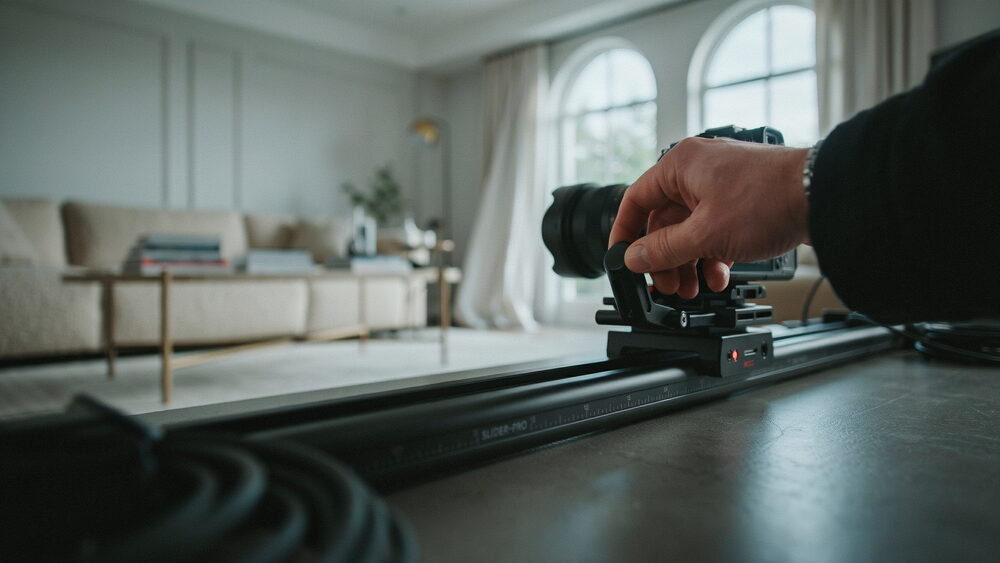
Premium property films live or die on camera movement. We favour slow, deliberate dolly shots and gimbal glides that mirror how a buyer's eye travels through a space. A 45-second continuous take through a penthouse foyer, past the marble island, and onto the terrace tells a story that jump cuts cannot. The movement itself becomes part of the architecture. That's what separates a listing video from a cinematic asset.
Lighting is the second pillar. We shoot at golden hour whenever possible, using large diffusion panels to soften Dubai's harsh midday sun. Interior scenes get layered practicals and hidden LED panels so windows never blow out. The goal isn't to make a property look bright. It's to make it look expensive. A well-lit film reads as effortless, even when it took six hours to set up.
Composition follows the rule of thirds but bends it for verticality. High ceilings, double-height windows, and cantilevered terraces demand wide lenses and low angles that exaggerate scale without distortion. We frame every shot with a clear foreground, midground, and background so the eye has somewhere to travel. This is where video production craft becomes spatial storytelling: each frame must work as a still photograph, not just as motion.
Pacing ties it together. A luxury property film should breathe. We hold shots for four to six seconds, cut on architectural lines, and let ambient sound carry transitions. The result is a rhythm that feels unhurried but never slow. When a client asks for a film that feels like a private viewing, this is the discipline we apply: every second earns its place, and nothing is rushed.
From Pre-Production to Final Cut: Our Workflow
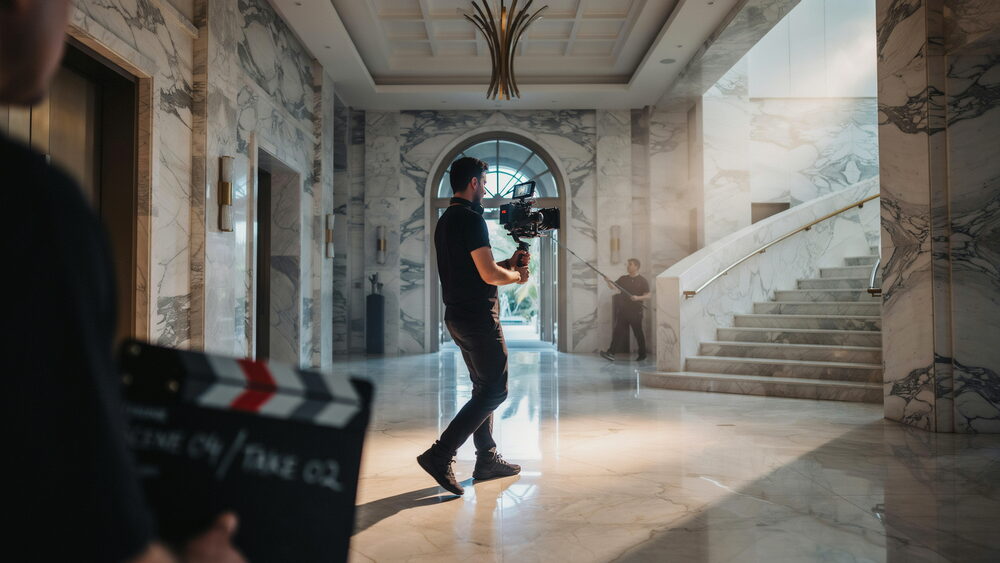
Every project begins with a location scout that goes beyond square footage. We study how natural light moves through the space at different hours, identify the architectural lines that deserve emphasis, and flag any logistical constraints like narrow hallways or reflective surfaces. This groundwork shapes a storyboard that sequences each shot for emotional rhythm, not just coverage. For Dubai developers, this often means capturing the transition from a sun-drenched terrace to a cool, shadowed interior in a single continuous move. That technique makes the property feel lived-in before a single piece of furniture arrives.
During the shoot, our crew works with a lean footprint: a director, a camera operator, and a gaffer who handles lighting and grip. We shoot in 6K or 8K raw so that color grading in post can recover highlight detail from marble floors and deep shadows in a walk-in closet. Our approach treats each room as a character, using slow dolly moves and locked-off wide shots that let the architecture breathe. We also record ambient sound on location, from the click of a door latch to the distant call to prayer, because silence in a property film feels sterile.
Editing is where the narrative tightens. We cut to a music track that matches the brand's tempo, usually a minimalist piano or a soft electronic pulse, and we never let a shot linger past its emotional payoff. Color grading follows a consistent palette across all deliverables, so the same villa looks identical in a 60-second social cut and a 3-minute website hero. Our service video production includes delivery in every format a developer needs: vertical 9:16 for Instagram Reels, square 1:1 for LinkedIn, and 16:9 for YouTube and the project's landing page. We also provide a raw footage archive, so your team can pull stills or recut later without paying for a reshoot.
Trends Shaping Videography Production in 2026
Aerial footage has moved from a luxury add-on to a baseline expectation for Dubai developments. Drones now capture sweeping coastlines, skyline context, and the scale of a master-planned community in a single continuous shot. We pair 8K drone work with ground-level gimbal moves so the transition from sky to lobby feels like one choreographed sequence rather than two separate clips.
Virtual staging is the second shift we see across every brief. Instead of waiting for furniture to arrive from Milan, we composite photorealistic interiors into empty shells during post-production. This lets developers launch off-plan campaigns months earlier. Buyers can visualise a penthouse at dusk, with soft lamp light and a styled terrace, before a single wall is painted. The result is a cinematic filming experience that feels finished, even when the site isn't.
Vertical formats are no longer optional. A 9:16 cut of the same hero film now runs on Instagram Reels, TikTok, and WhatsApp status, while the 16:9 master lives on the project website and YouTube. We shoot with both crops in mind from day one, protecting the top and bottom of frame so no balcony or infinity pool gets lost in the reframe.
AI-assisted editing is the quiet engine behind faster turnarounds. Automated colour matching, sky replacement, and object removal trim days from the edit without touching the creative core. We use these tools to handle repetitive tasks, then our editors spend the saved time on pacing, sound design, and the emotional arc that makes a property film feel like a story. The middle of any videography production now moves at twice the speed it did two years ago. That speed is what lets a developer launch a full campaign while the market is still hot.
We also see a return to longer, slower shots in luxury work. Where commercial real estate once chased fast cuts, high-end buyers now respond to unhurried reveals: a 12-second glide through a marble foyer, a slow tilt up a glass facade, a held frame on a private beach at golden hour. This patience is a trend in itself, and it rewards the kind of deliberate videography production that premium developments deserve.
Choosing the Right Partner for Your Development
Selecting a videography production partner is a decision that shapes how your property is perceived before a single buyer walks through the door. We advise Dubai developers to look beyond a glossy showreel and evaluate three things: portfolio depth, local market fluency, and post-production strength. A team that has filmed only hotels will struggle to capture the emotional arc of a branded residence. A crew unfamiliar with the emirate's light and architectural rhythm will miss the golden-hour moments that sell penthouses.
Ask to see full films, not just highlight reels. The best partners show you how they handle pacing, sound design, and color grading across an entire project. Local knowledge matters more than most developers expect: a team that knows how to secure permits for drone work over Dubai Marina, or how to schedule shoots around the heat and humidity of August, saves you weeks of delays. Post-production is where mediocre footage becomes cinematic. Confirm that the partner has in-house colorists, motion graphics artists, and a sound engineer who understands the quiet luxury of a well-mixed room tone.
We recommend a trial project before committing to a multi-tower campaign. A single 60-second teaser for one unit reveals how the team communicates, meets deadlines, and handles revisions. The right partner treats your development as a brand, not a one-off listing, and builds a visual language you can reuse across sales galleries, investor decks, and social campaigns for years. If you're evaluating agencies, our work page shows full films from recent Dubai developments, and our contact page makes it easy to start a conversation.
Frequently Asked Questions
How much does luxury real estate videography production cost?
Expect to invest between AED 15,000 and AED 60,000 per property film in Dubai, depending on drone coverage, cinematic lighting, and editing depth. Premium developers often budget 1-3% of the listing price, because a single high-end video can shorten days on market by weeks.
How long should a luxury property video be?
For social media and listing portals, 60-90 seconds is ideal. For private client presentations or full development showcases, 2-4 minutes works better. We always cut a 15-second teaser, a 60-second hero film, and a longer walkthrough so every platform gets the right length.
Do you need a drone license for real estate videography in Dubai?
Yes. Commercial drone filming in the UAE requires a GCAA-approved operator certificate and a no-objection certificate for each flight location. Our in-house pilots hold both, and we handle all airspace approvals so your project never faces delays or fines. You can review the GCAA's official requirements on their website.
What is the difference between videography and cinematography for property films?
Videography documents a space efficiently, while cinematography shapes light, movement, and mood like a feature film. For luxury real estate, we blend both: precise architectural coverage, plus cinematic camera language that makes a penthouse feel like a private resort.