
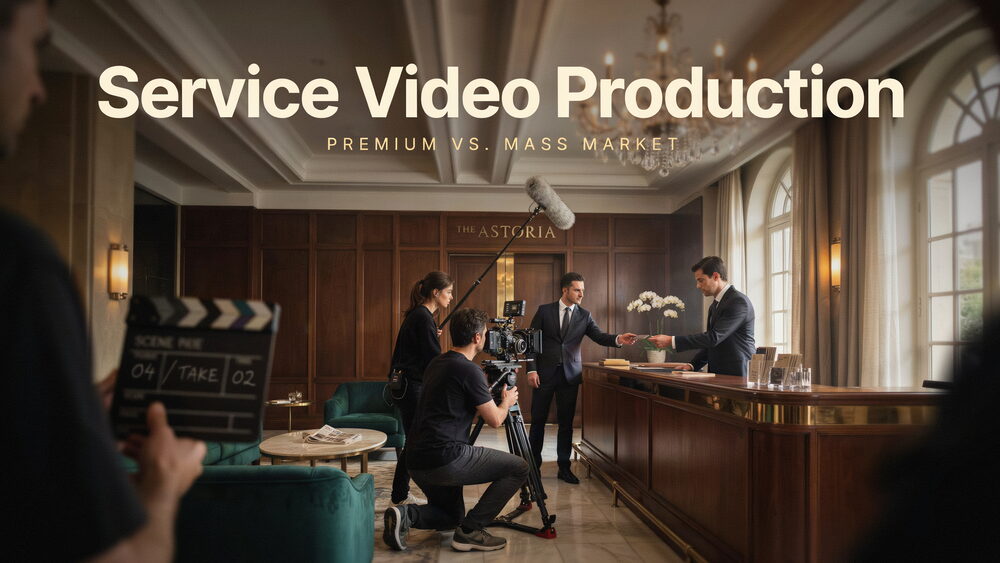
Service video production is not a one-size-fits-all discipline, and the gap between a premium brand film and a mass-market product spot is wider than most developers and luxury lifestyle brands in Dubai realise. We work with ambitious property developers and high-end creative teams every day, and the first question we ask is never about cameras or lighting rigs. It's about intent: are we building a brand asset that will live for years, or are we engineering a conversion engine that must perform in the first three seconds? This guide breaks down exactly how service video production differs for premium versus mass-market brands, from narrative depth and production value to pacing, sound design, distribution, and budget allocation. By the end, you'll know which decisions actually move the needle for your audience and your ROI.
Key Takeaways
- Premium service video production builds brand equity and emotional resonance, while mass-market work prioritises conversion and speed.
- Dubai developers and luxury brands should invest in narrative depth, cinematic visuals, and bespoke sound design to justify premium positioning.
- Distribution strategy differs sharply: premium brands favour curated placements and private screenings; mass-market brands need volume and platform-native formats.
- Success metrics must align with intent: brand lift and engagement for luxury, direct response and cost-per-acquisition for volume plays.
- Choosing the right luxury video production partner means prioritising creative alignment over price, especially for high-stakes brand campaigns.
Strategic Intent: Brand Building vs. Conversion
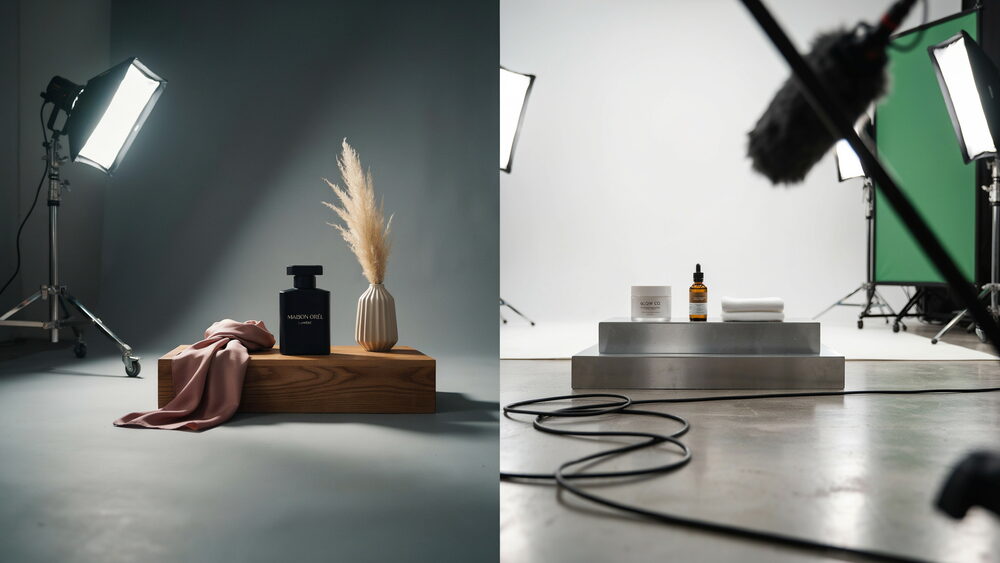
When we plan service video production for a premium Dubai developer, the first question is never about click-through rates. It's about whether the film makes the viewer feel the weight of the brand's promise. Luxury audiences don't need to be persuaded to act immediately; they need to be convinced that the brand understands their world. A three-minute film for a Palm Jumeirah penthouse might spend forty seconds on the way light moves across a marble floor, because that detail signals permanence, taste, and exclusivity. The conversion happens later, when the buyer walks into the sales gallery already believing the story.
Mass market brands invert that logic. Their service video production is built around a single measurable action: book a viewing, claim a discount, call today. Every frame is tested against a cost-per-lead target. A thirty-second spot for a mid-market apartment tower in JVC will open with the price, show the floor plan, and end with a phone number. There's no room for a lingering shot of a door handle. The emotional register is urgency, not aspiration.
This difference shapes every downstream decision. For premium work, we protect the brand's visual identity at all costs, even if that means a longer edit or a more expensive grade. For volume campaigns, we protect the offer. A luxury video production brief might forbid a single on-screen discount, while a mass market brief might demand three price mentions in the first ten seconds. Neither approach is wrong; they're simply aimed at different buyers.
The risk comes when a brand tries to do both at once. A premium developer that chases direct-response metrics will cheapen its identity. A mass market brand that tries to look like a luxury campaign will confuse its audience and waste budget. Our job in service video production is to know which game we're playing before the camera rolls, and to keep every creative choice aligned with that strategic intent.
Storytelling and Narrative Depth

In premium service video production, the story rarely begins with the product. It begins with the world the brand has built over years, sometimes generations. We think of the narrative as a layered film, not a commercial: heritage, craftsmanship, the quiet confidence of exclusivity, and the people who carry that legacy. A luxury developer in Dubai doesn't need to explain that the penthouse has marble floors. The story is the architect's obsession with light, the private beach at dawn, the concierge who remembers a client's preferred temperature for still water. These details accumulate into a feeling of belonging to something rare.
Mass market brands, by contrast, tell simpler, benefit-led stories. The narrative is direct: here is the problem, here is the solution, here is why you should act now. A video for a mid-range furniture retailer might show a family assembling a sofa in under ten minutes, with a voiceover listing free delivery and a ten-year warranty. There's nothing wrong with this approach. It respects the viewer's time and answers a practical question. But it doesn't create longing.
For luxury lifestyle brands, luxury video production becomes a form of world-building. We often structure the narrative around a single sensory detail: the sound of a fountain in a private courtyard, the weight of a hand-stitched leather portfolio, the way a watch catches candlelight. That detail becomes the emotional anchor. The viewer may forget the specifications, but they remember the feeling. This is why premium service video production invests so heavily in narrative depth: the story is the product as much as the product itself.
Mass market storytelling, by necessity, optimizes for clarity and speed. A brand strategy and development consulting services market report might call this the difference between brand equity and performance marketing. Premium brands buy equity; mass brands buy attention. Both are valid. The mistake is applying one narrative logic to the other. A luxury brand that rushes to a discount message erodes its mystique. A mass brand that tries to be mysterious simply confuses its audience.
We advise our Dubai-based clients to think of narrative depth as a spectrum, not a binary. Even within a single campaign, a premium developer might release a 90-second heritage film for the brand channel and a 15-second benefit-led cut for paid social. The deeper story lives on the website and in the showroom; the simpler story lives in the feed. The key is that the deeper story exists. Without it, the short cuts have nothing to point back to.
Production Value and Visual Language
In service video production, the gap between premium and mass market shows up most clearly in the frame itself. A luxury developer in Dubai expects every shot to feel like a still from a high-end editorial spread, while a mass market brand often accepts a cleaner, more functional look that prioritises speed over atmosphere. We approach both with the same technical rigour, but the visual language shifts dramatically.
Cinematography is the first differentiator. For premium clients, we lean on anamorphic lenses, shallow depth of field, and deliberate camera movement that mirrors the architecture's own geometry. A slow push-in across a marble lobby or a crane shot over an infinity pool communicates permanence and exclusivity. Mass market work, by contrast, favours faster cuts, wider lenses, and more handheld energy, because the goal is to hold attention on a feed, not to invite contemplation.
Lighting follows the same logic. Premium service video production often uses large soft sources, practicals, and negative fill to sculpt shadows and reveal texture in stone, fabric, and metal. We might spend an hour lighting a single hero product shot. For mass market, we work with brighter, flatter setups that keep every detail visible and reduce post-production time. Set design is equally telling: a luxury shoot might involve a fully dressed penthouse with curated furniture and art, while a mass market shoot often uses a clean studio or a real location with minimal styling.
Talent and wardrobe matter too. Premium brands typically cast models or presenters who match the aspirational identity of the audience, with styling that feels editorial rather than commercial. Mass market brands often prefer relatable, everyday faces. Post-production polish is where the gap widens further: premium projects get dedicated colour grading sessions, film grain, and subtle VFX cleanup, while mass market edits stay crisp, bright, and ready for quick turnarounds. This is why luxury video production budgets routinely run three to five times higher, and why the right partner matters from the first storyboard.
Pacing, Length, and Format
Premium audiences reward patience. A luxury brand film often runs two to four minutes, with slow dissolves, deliberate camera moves, and long pauses that let craftsmanship breathe. Mass market viewers, by contrast, expect a hook in the first three seconds and a complete message inside 30 seconds. That difference shapes every edit decision we make in luxury video production.
For a Dubai developer launching a branded residence, we might produce a 90 second hero film for the website, a 15 second cut for Instagram Reels, and a 6 second teaser for programmatic display. The pacing stays unhurried in the hero film, then tightens progressively for each shorter format. Mass market brands often reverse that logic: they shoot one fast paced 30 second spot and extend it with supers and end cards rather than re editing for each platform.
Format choices follow the same split. Premium work leans on cinematic 24fps, anamorphic lenses, and 4K or 6K masters that hold up on large screens at sales galleries. Mass market content prioritises vertical 9:16 framing, bold captions, and square crops that survive muted autoplay in a feed. Neither approach is wrong; they simply serve different attention economics.
We also consider where the video lives. A premium brand can afford a slower build on YouTube or a private client portal, where the viewer has chosen to watch. A mass market brand competes inside a scroll, so the first frame must carry the entire value proposition. That single insight, platform intent, often matters more than any rule about ideal video length.
Sound Design and Music Licensing
Premium brands treat sound as a signature, not an afterthought. We commission original scores from composers who understand the emotional architecture of luxury, layering bespoke sound design under every frame so that a door closing or a fabric rustle feels intentional. This level of service video production gives a film its own acoustic identity, one that cannot be licensed by a competitor and that reinforces brand recall long after the screen goes dark.
Mass market work, by contrast, leans on stock music libraries and faster turnarounds. A video production firm serving high-volume clients may pull a trending track, drop it under the edit, and ship within days. The result is competent but generic: the same audio bed appears in a hundred other ads, and the brand's voice never quite emerges. That tradeoff makes sense when the goal is volume and cost control, but it quietly caps emotional impact.
Licensing is where the gap widens. Premium productions clear custom compositions with full buyout rights, avoiding future royalty disputes and keeping the asset evergreen. Stock tracks, even from reputable libraries, carry usage restrictions that can surface years later, especially when a campaign scales across new territories. For Dubai-based developers launching a flagship tower, an original score is not a luxury line item; it's the difference between a film people watch and a film people feel. We have seen a single bespoke cue lift a project's perceived value more than any color grade ever could.
Distribution and Channel Strategy
Where a video lives says as much about the brand as the film itself. For premium developers in Dubai, distribution is curated and controlled: private screenings at gallery openings, invitation-only events at the project site, and a dedicated brand channel on YouTube that feels more like a digital showroom than a content feed. We often pair a cinematic brand film with a shorter, gated version for investor relations, so the full experience stays exclusive while the teaser circulates among high-net-worth networks and private bankers.
Mass market brands play a different game. Their service video production is built for reach, so the same core edit gets cut into 15-second verticals for TikTok and Reels, a 30-second mid-roll for YouTube, and a 6-second bumper for programmatic display. The goal is frequency and retargeting: a prospect who watched the first five seconds on Instagram sees the full story later on a connected TV placement. We structure the shoot with this in mind, capturing wide establishing shots that crop cleanly for vertical and close-ups that hold attention on a phone screen.
The middle path, what we call accessible luxury, blends both. A hospitality brand might premiere a two-minute film on its own site and YouTube, then run shorter cutdowns across Meta and LinkedIn, where the audience includes corporate travel managers and event planners. This tiered approach keeps the premium feel intact while still feeding the algorithm enough native content to perform. For any tier, the channel decision drives the edit, not the other way around, which is why we map distribution before a single frame is shot.
Measuring Success: KPIs That Matter
When we measure the performance of service video production for premium brands, the scorecard looks fundamentally different from the one a mass market campaign uses. Premium video is rarely judged by raw view counts alone. We track brand lift, measured through pre- and post-campaign surveys that capture shifts in awareness, consideration, and perceived exclusivity. Share of voice within luxury lifestyle publications and high-end social feeds tells us whether the film is earning attention in the right rooms. Engagement quality matters more than quantity: a single thoughtful comment from a qualified buyer in a private wealth group outweighs a thousand passive likes from an unqualified audience.
Mass market video, by contrast, lives and dies by the funnel. View counts, click-through rates, and cost per acquisition are the north stars. A video that drives a 2% CTR at a $0.40 CPA is a winner, even if nobody remembers it a week later. The creative brief is built around stopping power and a clear call to action, not emotional resonance. That's not a criticism; it's simply a different job. A video for a fast-moving consumer good must convert in the first three seconds, while a video for a private villa development in Dubai must make the viewer feel something they cannot get anywhere else.
The danger comes when a premium brand borrows mass market KPIs and concludes that service video production failed because it didn't generate 100,000 views. We have seen luxury developers panic over a video that reached only 8,000 people, even though those 8,000 included three serious off-plan buyers and a regional architecture critic. The right KPI framework protects the brand from that mistake. For premium work, we recommend a blended scorecard: 40% brand lift, 30% engagement quality, 20% qualified lead generation, and 10% reach. For mass market, invert it: 60% conversion metrics, 25% reach, 15% engagement. Neither framework is wrong; each is honest about what the video was built to do.
Budget Allocation and ROI Expectations
Budget conversations for service video production often stall because premium and mass market brands define value differently. A mass market campaign might allocate AED 50,000 to AED 150,000 for a single product film, with most of that going to crew, equipment rental, and a fast post-production turnaround. A luxury developer in Dubai, by contrast, can spend AED 500,000 to AED 2 million on a flagship property film, where location scouting, art direction, and a bespoke musical score each consume a larger share than the camera package itself.
Where the money goes tells you what the brand is buying. Mass market budgets skew toward volume: multiple edits for A/B testing, short-form cuts for paid social, and a production schedule measured in days. Premium budgets skew toward permanence: a single hero film that will anchor the brand for three to five years, shot over a week or more, with color grading and sound design treated as signature assets rather than finishing touches. We see this split in our own work with luxury video production clients, where the line item for a custom soundtrack alone can exceed an entire mass market production budget.
ROI definitions follow the same divide. Mass market brands measure cost per acquisition, view-through rate, and direct sales lift within a 30-day window. Premium brands measure brand equity: share of voice in editorial coverage, inbound inquiries from qualified buyers, and the resale value of the film across multiple channels over several years. Neither is wrong, but applying a mass market ROI lens to a premium service video production project guarantees disappointment, just as applying a brand equity lens to a performance campaign guarantees overspend.
A practical rule we use with clients: allocate 10 to 15 percent of the production budget to pre-production, 50 to 60 percent to the shoot itself, and 25 to 35 percent to post-production and distribution. For premium work, shift that distribution slice toward fewer, higher-impact placements rather than broad paid reach. The goal is not to spend more, but to spend where the audience actually assigns value.
Choosing the Right Video Production Partner
Selecting a partner for service video production in Dubai is not a vendor decision; it's a brand decision. The agency you choose will shape how your development or lifestyle brand is perceived by investors, buyers, and the media, so we evaluate potential partners against three criteria: portfolio depth in the luxury sector, strategic thinking beyond the shoot, and a production process that protects your schedule and reputation.
First, look for a luxury video production portfolio that shows restraint, not spectacle. Premium brands don't need drone shots of every angle; they need controlled light, considered composition, and sound design that feels expensive. Ask to see full case studies, not just highlight reels, and pay attention to how the agency handled architectural details, fabric textures, and natural light. A partner who understands the difference between a showroom walkthrough and a cinematic brand film will save you from content that looks like a real estate listing when you wanted a heritage piece.
Second, confirm that the agency can connect video to your broader brand strategy. The best service video production firms don't just execute a script; they interrogate the brief. They ask about your positioning, your competitors, and the emotional response you want from a viewer in the first eight seconds. This is where brand strategy and development consulting services market expertise becomes a differentiator. An agency that treats video as an isolated deliverable will produce beautiful footage that doesn't move your brand forward. We look for partners who bring a strategist to the kickoff meeting, not just a director and a producer.
Third, evaluate the production process itself. Dubai timelines are tight, and a video shoot at a flagship property or a private residence requires discretion, permits, and contingency planning. Ask how the agency handles weather delays, talent changes, and post-production revisions. A partner with a clear approval workflow and a single point of contact will protect your time. We also recommend checking whether the agency has experience with the specific channels where your video will live, because a film optimized for a cinema screen is not the same as one optimized for Instagram Reels or a private investor presentation.
Finally, don't choose on price alone. Premium service video production is an investment in your brand's perceived value, and the cheapest bid often costs more in reshoots, missed deadlines, and content that underperforms. We advise Dubai developers and luxury brands to shortlist two or three agencies, request a paid test project, and then commit to the partner who demonstrates both craft and commercial judgment. The right partner becomes an extension of your marketing team, not a supplier you manage from a distance.
Frequently Asked Questions
How does service video production differ for premium vs. mass market brands?
Premium brands invest in cinematic storytelling, subtle color grading, and bespoke sound design to convey exclusivity. Mass market work prioritizes speed, volume, and direct calls to action. The same service video production team can deliver both, but the creative brief, budget, and distribution plan change dramatically.
What should a luxury brand expect from a video production firm?
Expect a dedicated producer, access to high-end equipment, and a review process that protects brand equity. A video production firm serving luxury clients will also handle licensing, talent, and location logistics discreetly, often under NDA, so the final film feels effortless and aligned with your brand positioning services Dubai.
How much does premium service video production cost compared to mass market?
Premium projects typically start at AED 50,000 and can exceed AED 250,000 for multi-day shoots with celebrity talent or international locations. Mass market videos often run AED 8,000 to AED 25,000. The gap reflects crew size, equipment, post-production hours, and the level of creative direction involved.
Which metrics matter most for premium vs. mass market video campaigns?
Premium brands track watch-through rate, brand lift, and qualified lead quality. Mass market campaigns optimize for cost per view, click-through rate, and conversion volume. A strong video production services partner will define these KPIs before shooting, so the edit supports the measurement plan from day one.
Can one video production company handle both premium and mass market work?
Yes, if the team has separate creative pods and clear processes. We often run a luxury division for high-touch clients and a volume team for performance campaigns. This keeps the craft standards high while meeting aggressive deadlines, which is why many ambitious Dubai developers choose a single multimedia company for both streams.